

Running a small business is a popular way to make a living. However, it often comes with a low success rate, which is widely acknowledged (here). To increase their chances of success, many people consider franchising as a smart and practical option. Franchising offers the advantage of a proven business system already in place, allowing individuals to leverage it for profitability. For instance, opening a Starbucks franchise is believed to yield higher success compared to starting an independent coffee shop. In this article, we will explore whether franchising provides a greater opportunity for financial success.
What Is Franchising?
Let’s begin by understanding franchising for those who are new to this topic. According to International Franchise Association (IFA),
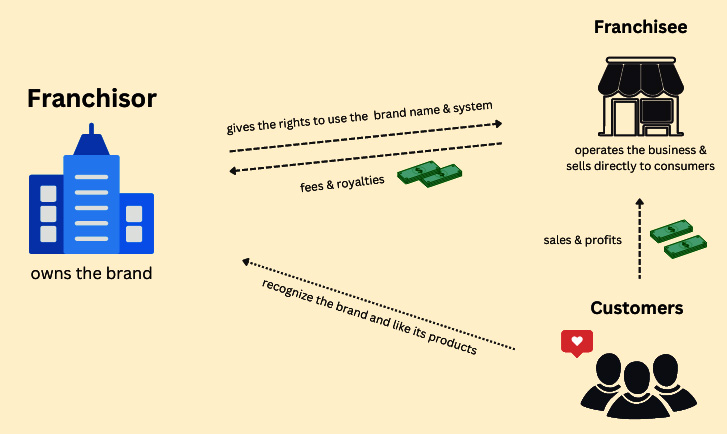
A franchise (or franchising) is a method of distributing products or services involving a franchisor, who establishes the brand’s trademark or trade name and a business system, and a franchisee, who pays a royalty and often an initial fee for the right to do business under the franchisor’s name and system.
Therefore, if you establish a McDonald’s outlets, you will be the franchisee and McDonald’s will be the franchisor.
Franchising allows the franchisee to operate a business that has a proven track record and a recognized brand name. The franchisor typically provides training, guidance, and ongoing support to the franchisee, ensuring that they follow the established business model and maintain the standards set by the franchisor.
Franchising offers several benefits to both the franchisor and the franchisee. For the franchisor, it allows for the rapid expansion of their business without having to invest heavily in new locations or manage them directly. Franchisees benefit from the established brand, access to a proven business model, marketing support, and the opportunity to run their own business with a higher likelihood of success compared to starting a business from scratch.
Franchises can be found in various industries, including food and beverage, retail, hospitality, services, and more. Examples of well-known franchises include McDonald’s, Subway, Hilton Hotels, and UPS.
It’s important to note that franchising involves a legal agreement between the franchisor and franchisee, outlining the terms and conditions of the relationship, including fees, obligations, and territorial rights. Prospective franchisees should thoroughly research and understand the terms of the franchise agreement before entering into such a business arrangement.
Does Franchising Make Money?

The profitability of a franchise can vary depending on numerous factors, including the industry, the specific franchise brand, the location, the franchisee’s management skills, and the overall economic conditions. While franchising offers a higher likelihood of success compared to starting a business from scratch, it does not guarantee profitability.
The success rate of franchisees can be influenced by several factors. According to various studies and reports, the success rate of franchise businesses tends to be higher than that of independent startups. However, it’s essential to note that success rates can vary across industries and individual franchises.
The International Franchise Association (IFA) in the United States has reported that franchises generally have a higher success rate than independent businesses. According to their data, about 85% of franchises are still in operation after five years, compared to approximately 50% of independent businesses. However, it’s important to note that these figures are not universal and can vary depending on the industry and other factors.
The success of a franchisee also relies on their ability to effectively manage the business, follow the franchisor’s established system, adapt to local market conditions, and provide quality customer service. Thoroughly researching and understanding the franchise opportunity, including analyzing the franchise disclosure document, conducting due diligence, and seeking advice from professionals, can increase the chances of success.
It’s advisable for prospective franchisees to thoroughly evaluate the franchise opportunity, assess the financial aspects, and consider factors such as the demand for the product or service, competition, location, and support provided by the franchisor. Additionally, speaking with existing franchisees within the system can provide valuable insights into the potential profitability and overall experience of operating a particular franchise.
Does Franchising REALLY Make Money?
What you read above is what the International Franchise Association (IFA) states. It is likely true that 85% of franchises are still in operation after five years. However, the question remains: How much money do they actually make? Another important consideration is the amount of money franchisees have to risk/invest to start a franchise business.
According to Investopedia,
Buying a franchise might seem like easy money, but those royalties and fees will quickly cut into profit margins. The majority of franchise owners earn less than $50,000 per year.
How Much Does a Franchisee Have to Spend/Risk to Start a Franchise Business and What Are the Royalty Fees?
The costs and fees vary greatly depending on the franchisor chosen. However, to provide you with some insight, let’s examine the cost of starting a McDonald’s outlet in New York:
1. Initial Franchise Fee:
The initial franchise fee for a McDonald’s outlet can range from $45,000 to $60,000. Let’s assume a fee of $50,000 for this example.
2. Equipment and Inventory:
The cost of kitchen equipment, furniture, fixtures, and initial inventory can vary based on the size and specifications of the restaurant. Let’s assume an estimated cost of $500,000 for this example.
3. Leasehold Improvements:
Leasehold improvements encompass construction, remodeling, and interior design. The cost will depend on the condition of the premises and market factors. Assuming an estimated cost of $400,000 for this example.
4. Real Estate and Lease Costs:
The cost of real estate and lease expenses can vary widely depending on the location, size, and local market conditions. Let’s assume an estimated cost of $1,000,000 for this example.
5. Training Expenses:
While the cost of training is typically included in the initial franchise fee, there may be additional expenses related to travel and accommodation. Let’s assume an estimated cost of $10,000 for this example.
6. Royalty and Advertising Fees:
McDonald’s franchisees are required to pay ongoing fees. The royalty fee is generally a percentage of sales, often around 4% to 5%. Advertising fees are typically around 4% to 5% as well. Let’s assume an estimated monthly sales of $200,000. For this example, assuming a 4% royalty fee and a 4% advertising fee, the monthly fees would amount to $8,000 ($200,000 x 4%) for both royalties and advertising combined.
Considering the above estimates, the total cash needed to start a McDonald’s outlet in New York, based on this example, would be approximately $1,750,000 ($50,000 + $500,000 + $400,000 + $1,000,000 + $200,000).
Is That All?
No, that was just the tip of the iceberg. Franchisees are obligated to purchase their raw materials from their franchisors. However, franchisors charge franchisees higher prices for the raw materials they are required to buy. By charging higher prices for raw materials, franchisors can potentially increase their own profitability. This approach allows them to benefit directly from the franchisees’ operations and offset the costs associated with supporting and maintaining the franchise system.
On the other hand, franchisors often provide support services to franchisees, such as training, marketing assistance, ongoing operational guidance, and access to proprietary systems or technologies. The costs associated with providing these services may be factored into the pricing of the raw materials to ensure the franchisor can continue supporting the franchise network effectively.
Now that you know that franchising is not easy and requires a significant financial investment, let’s return to the question posed by the title of this article: Does Franchising Make Money?
Let’s once again use McDonald’s as an example. While specific financial information, such as the average earnings of McDonald’s outlets in New York, is not publicly disclosed by McDonald’s Corporation, it is commonly stated that the average McDonald’s restaurant franchise owner of an existing restaurant earns around $150,000 per year.
Based on research conducted by Franchise Business Review, it was revealed that the typical yearly earnings of franchise owners amount to approximately $80,000. However, numerous elements influence the income potential of a franchise, including factors like local demographics and foot traffic. Interestingly, the survey highlighted that a majority of franchise owners actually earn less than $50,000 annually, while a notable 7% achieve incomes exceeding $250,000.
Therefore, after investing over $1.5 million and bearing significant ongoing fees, your chances of earning $250,000 per year are less than 10%. In reality, you are more likely to either incur losses or generate an annual income of around $50,000.
Are You Still Interested in Pursuing Franchising?
Engaging in franchising under these circumstances would primarily benefit the franchisor, while subjecting you and your family to constant risks and challenges that could ultimately lead to business closure and financial setbacks.
You might ask if this is true, then why so many people are doing it?
They do it without enough research and investigation. Many of them get fooled by those who sell their franchise business. The seller says they want to sell their franchise business because they want to retire or move to another place and false reasons like that, but indeed they want to sell because it doesn’t make enough money and they have become tired of a struggling business.
You may wonder why so many people still choose to enter the franchising industry despite these drawbacks. The truth is that many individuals enter into franchising without conducting sufficient research and investigation. They often fall victim to misleading information provided by franchise sellers. These sellers may present false reasons for selling their franchise business, such as retirement or relocation, while the actual motivation is often inadequate profitability and exhaustion from running a struggling business.
What we do at LuckScout is poised to revolutionize everything. Our members have the opportunity to generate income without any financial risk, both through active and passive means that grow progressively. Although we have recently embarked on this journey, we are determined to surpass the big corporations that exploit individuals and their finances solely for their own enrichment. We invite you to join us and be part of this transformative movement!
You are in the right place at the right time…
We achieve our goals, not immediately, but slowly and surely!
Learn How Our System Works:

You can see the same video as slides:
More about this revolutionary system:
- LuckScout in Simple Words
- What LuckScout Is NOT
- LuckScout Is Created Based on Love❤️
- How Does LuckScout Work?
- Why Is LuckScout Innovative, Revolutionary and Unique?
- LuckScout Is a Strong Community to Make Everyone Strong
- The Safest and Best Way to Achieve Financial Freedom
- A Great Way to Achieve Financial Freedom
- LuckScout Looks Simple, But It Is the Most Advanced System Ever
- The Modern Form of Affiliate System
- How to Make Money Online No Experience No Investment No Scam
- How Long Does It Take to Succeed?!!
- Make Money While You Sleep😴
- Get Ready for the Luckscout Trading Program
- How Compound Interest Works With a Small Budget
- A Simple Success Formula that Works Like a Charm
- The LuckScout Compound Growth Engine
And please see these pages too:
- Make Money with LuckScout
- Your Points
- FAQs
- Become an Independent Self-Sufficient Wealth-Builder for Free and Risk-Free
Haven’t you joined The LuckScout Community yet???
Click Here to sign up.
See you on board!😃❤️🌺🌹💝🌸🎊🎉✨🌹👑🍺👏